All links and bibliography for this post can be found here, on my Pinboard account. If you encounter a dead link, an archived copy is available on Pinboard.
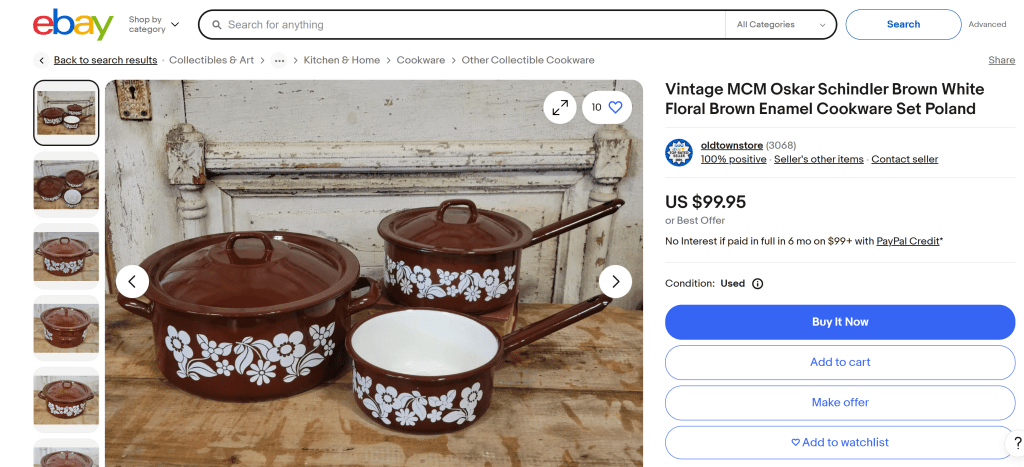
A few weeks ago, I was looking for vintage Polish cookware on eBay. I was coming across a bunch of lovely pieces, but one listing immediately caught my attention: “Vintage MCM Oskar Schindler Brown White Floral Enamel Cookware Set Poland1.” I clicked into it and scanned through the information, trying to figure out why Schindler’s name was attached to this. In the specifics section, “Oskar Schindler” was noted as the brand and the time period was marked as “1960-1969.” The description of the item, however, gave no mention of THE Oskar Schindler and his factory.
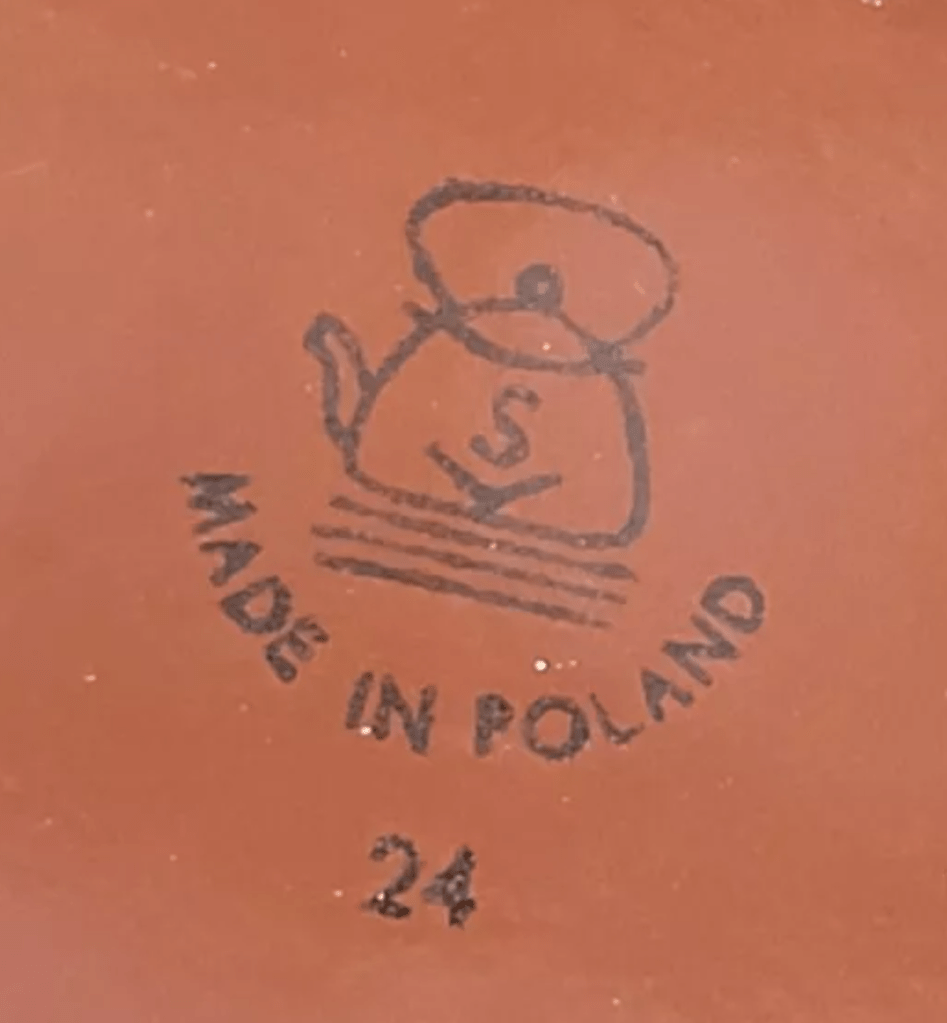
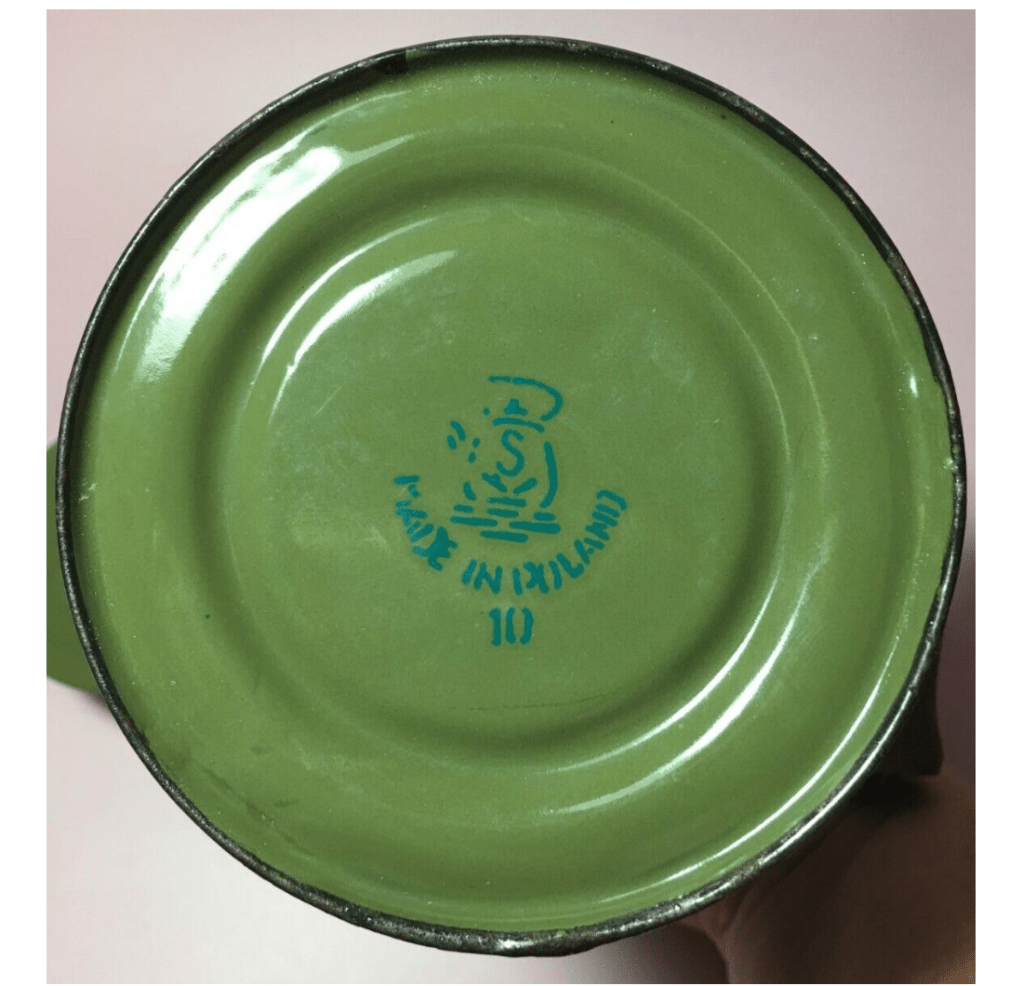
I took a look at maker’s mark on the item, a tea kettle with an “S” inside. Underneath, “MADE IN POLAND”, which made the whole listing even more nonsensical. Why was Oskar Schindler associated with this?
Before I get into enamel cookware, I want to establish some background on Oskar Schindler2 and his factory3. If you are familiar with Holocaust history, you likely know who he is. Most people who are around my age and older may remember the movie, “Schindler’s List”, which tells the story of how Oskar Schindler employed and protected Jews in his factory during WWII. The film was highly lauded and I remember watching scenes from it in high school. I’m not sure how familiar younger people are today with the film or the name Oskar Schindler, so I want to provide some background knowledge as well as some key pieces of information to keep in mind as you read this article.
In 1939, Poland was invaded by the Nazis. After the Polish army was defeated, most of western Poland was annexed to Germany, including the area where Kraków was located. Kraków then became Krakau and the capital of an area known as the General Government (Generalgouvernement)4. The Nazis had big plans for this newly acquired territory: colonization by German settlers while reducing Poles to a serf level then eventual genocide. For the Nazis, the state of Poland ceased to exist with their arrival and rule, and they carried out a brutal process of Germanization5 in the annexed areas. The goal was to wipe out all traces of Polish culture, language, and identity.
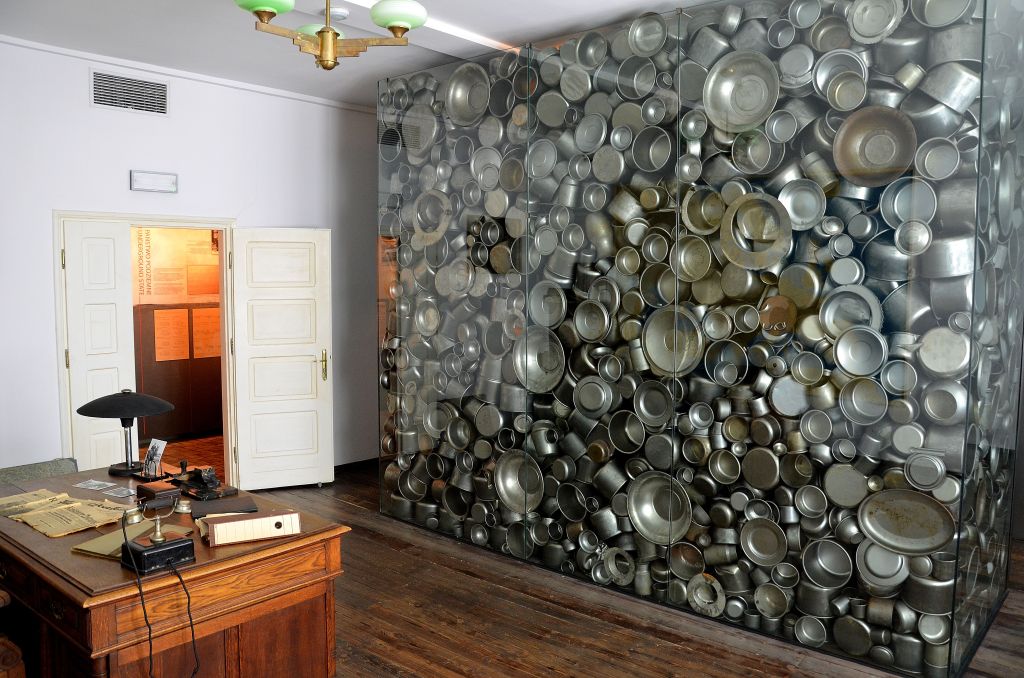
Oskar Schindler, a member of the Nazi party, took over an enamel company (“Rekord” ) in Kraków and renamed it “Deutsche Emailwarenfabrik” (DEF), or “German Enamelware Factory” in English. The company produced enamelware and ammunition for the Wehrmacht. In 1944, as the Soviet Army closed in on Kraków, Schindler was forced to relocate his factory to Brünnlitz6 (present-day Brněnec, Czech Republic). A list was made of the Jews he took with him and this evacuation saved their lives. Eventually, the Brünnlitz factory was liberated by the Soviets and Schindler was forced to flee. He spent the rest of his life destitute and living off the kindness of the Jews he saved. There was no “Oskar Schindler” brand of enamel cookware; his company ceased to exist after WWII. Poland came under communist rule and became a satellite of the Soviet Union. The factory building in Kraków was nationalized and became Krakowskie Zakłady Elektroniczne Unitra-Telpod, then later a museum dedicated to Oskar Schindler. You can visit it today.7 The second factory, in Brněnec, Czech Republic, was also nationalized when the communist government of the Czechoslovakia was instituted. The factory building has been abandoned since 2010, though there are plans to turn it into a museum.
At first, I thought the seller may be trying to get more views to their listing by plopping on Schindler’s name, essentially manipulating the search results, a frowned upon but often used tactic in online selling. But Schindler is an odd choice because this item was described as something you could still cook with today, whereas someone explicitly searching for Schindler enamelware most likely would be looking for it as a collector’s item. My curiosity kicked in and I started searching for other Oskar Schindler enamelware pieces.
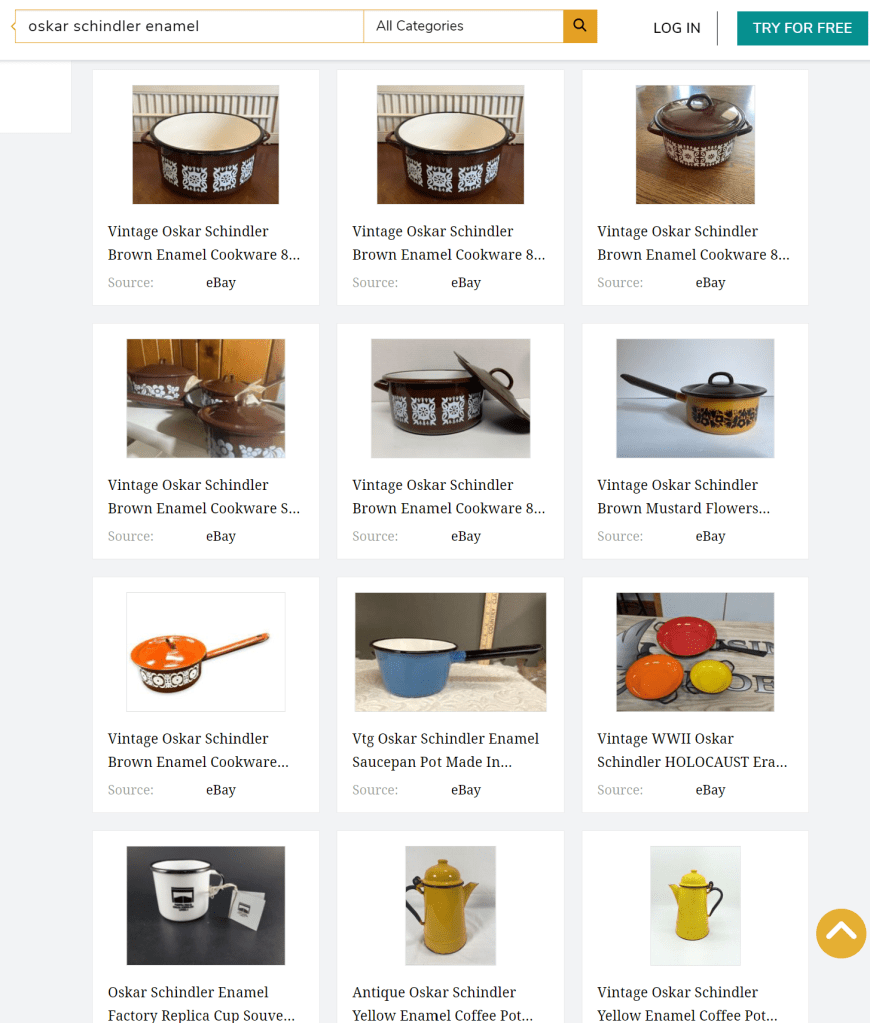
A search on Worthpoint8, a resource for pricing antiques and collectibles that indexes listings from eBay, shows 63 items (as of October 11, 2024) that were listed as Oskar Schindler enamel cookware, many of them bearing the same brown and white floral pattern as the previous listing mentioned.
Etsy won’t allow you to search sold items, but running a Google search of “Vintage Oskar Schindler Enamel site:etsy.com”9 will bring up past listings, and there are quite a few.
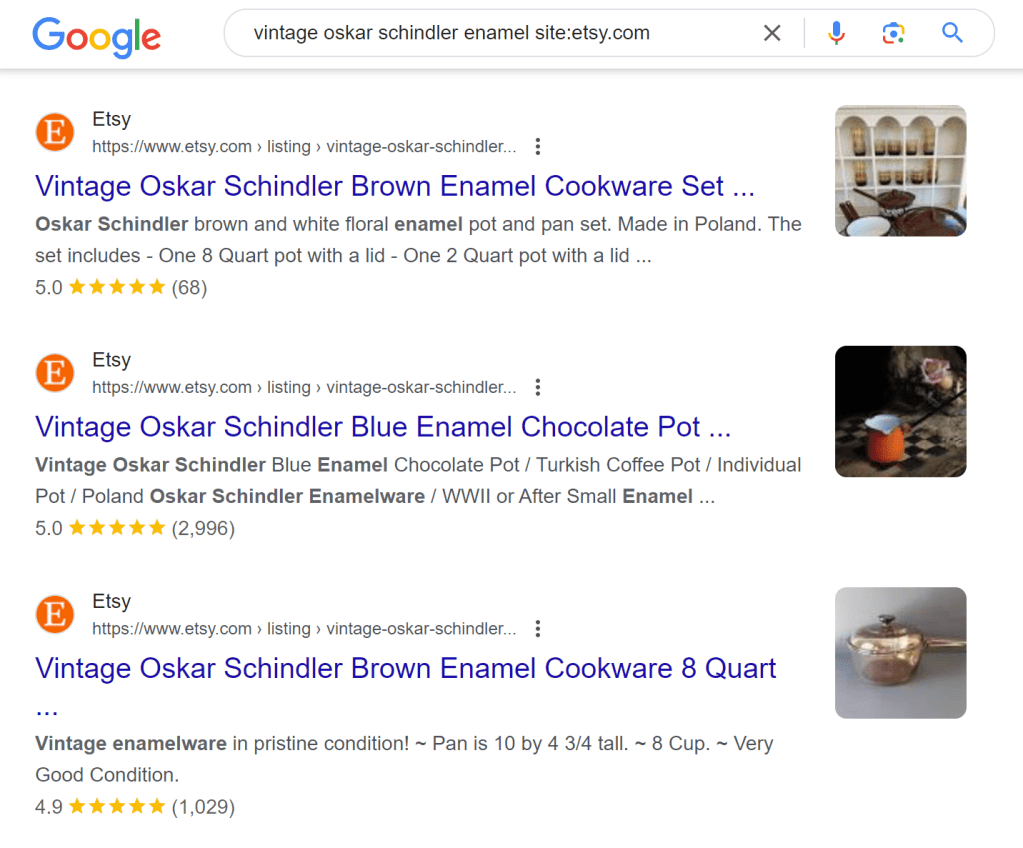
After inspecting many of the listings, I came to these conclusions: There are eBay and Etsy sellers who honestly do not know who Oskar Schindler is and think it’s a brand, like Ethan Allen. I believe that is the case in the first listing that caught my attention. The other conclusion was the seller genuinely thinks their piece of enamelware was produced in Oskar Schindler’s factory during the Holocaust. These listings are the ones I find unsettling, so let’s look at a few of them.
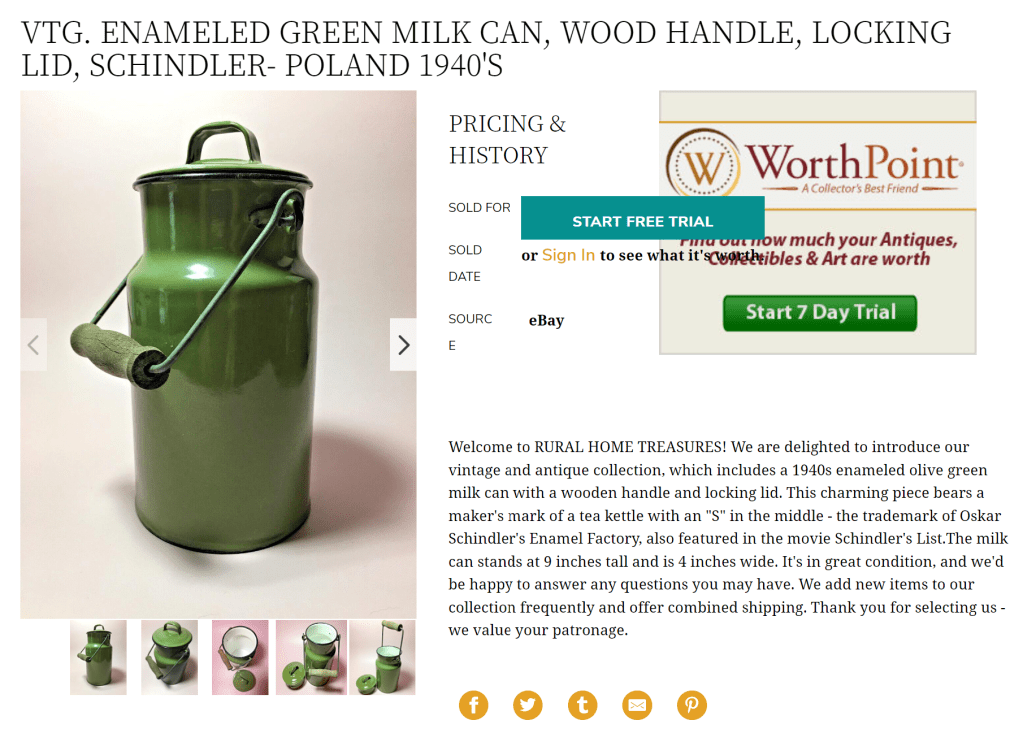
This listing10 comes from Rural Home Treasures and is titled “Vtg. Enameled Green Milk Can, Wood Handle, Locking Lid, Schindler-Poland 1940’s.” They confidently assert that this “charming” piece bears the trademark of Oskar Schindler’s Enamel Factory, a maker’s mark of a tea kettle with an “S” inside. There is a “MADE IN POLAND” stamp.
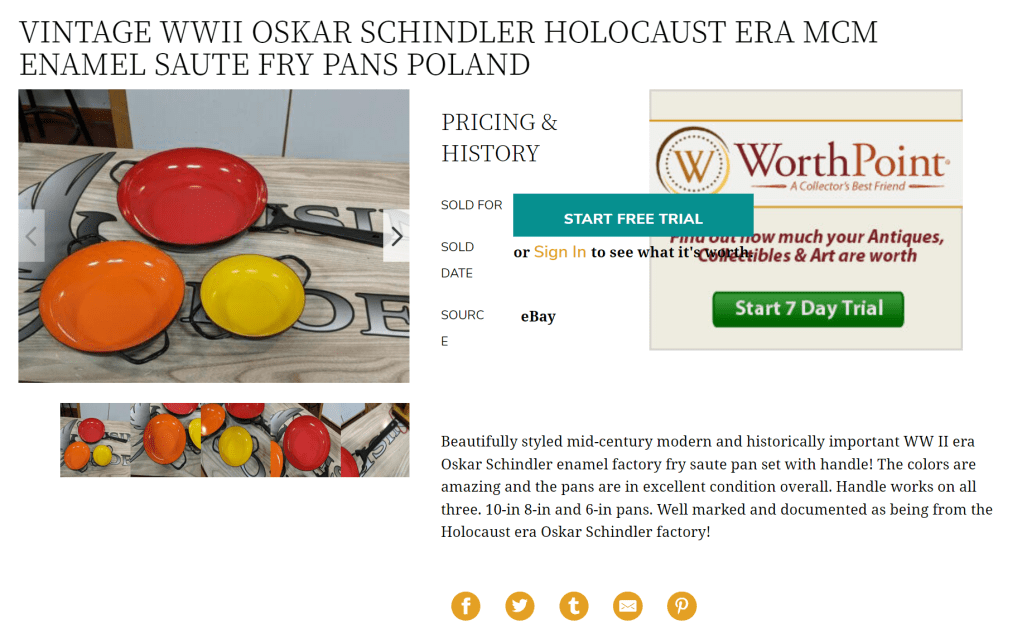
This listing11, from eBay, notes their item is historically important and also claims it’s documented as being from the Oskar Schindler factory. There’s a note about the condition of the handles, in case you want to fry up some eggs in them. The maker’s mark on this is another tea kettle with an “S” inside with the “MADE IN POLAND” stamped underneath.
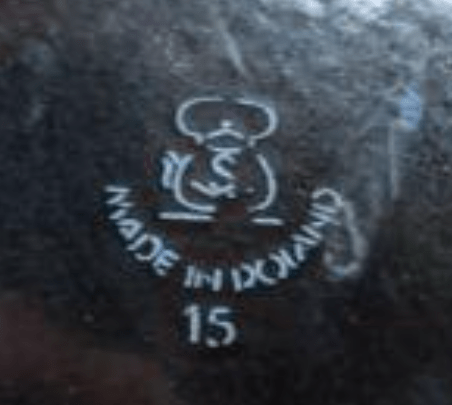
This listing comes from Etsy12. The seller lists their pot as made in Schindler’s factory and they think it’s just perfect for cooking soup or spaghetti in. For the buyer wanting to learn more about Oskar Schindler and his factory, the seller has provided links they undoubtedly did not read. The maker’s mark on this one is slightly different from the ones we’ve seen. It’s a tea kettle, but rather than an “S”, there’s an “O” inside. Again, another “MADE IN POLAND” stamp.
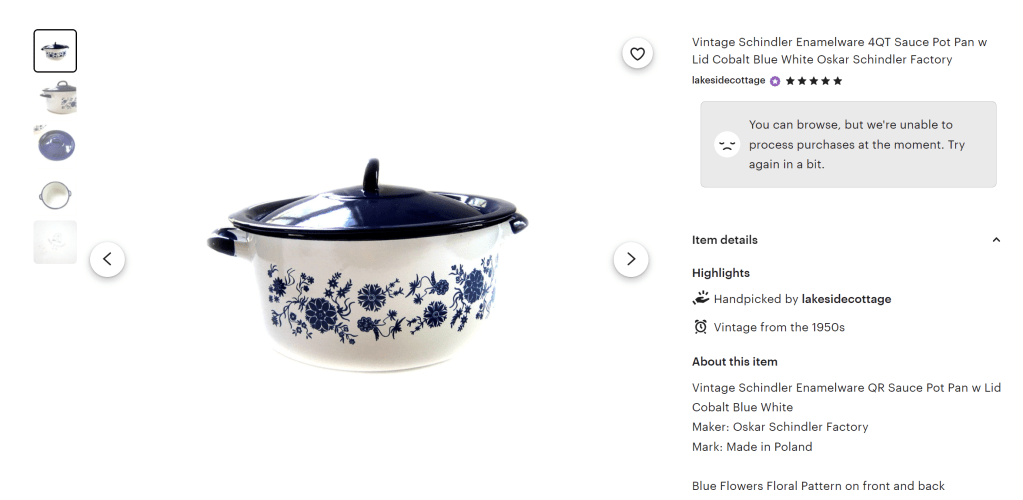
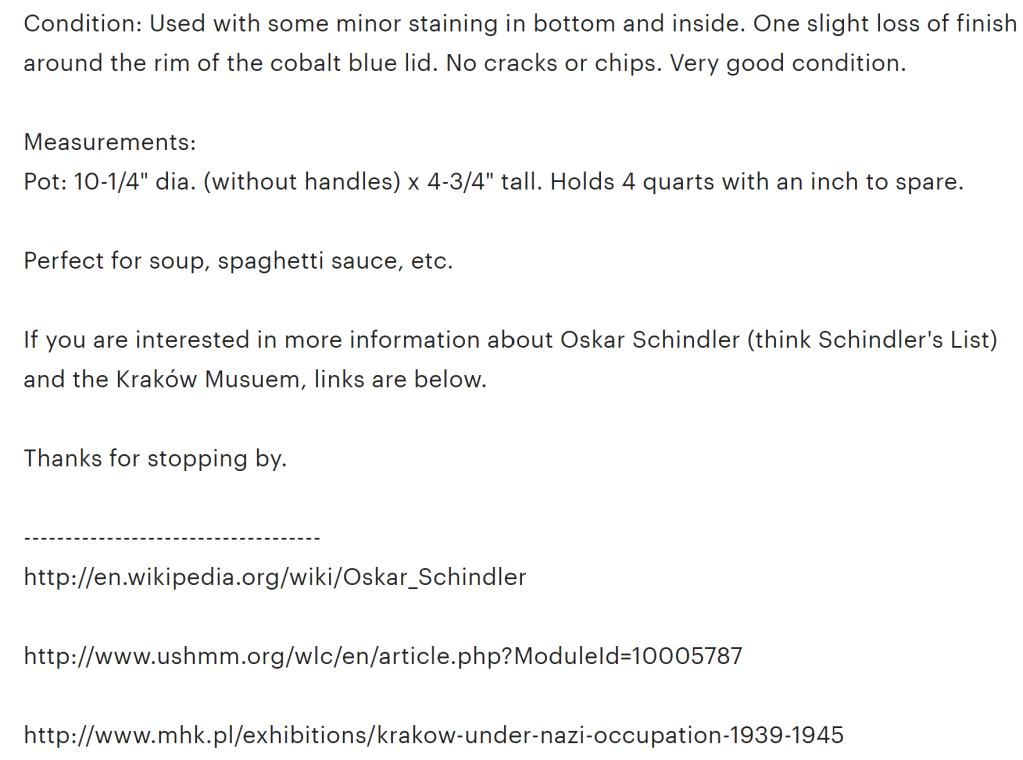
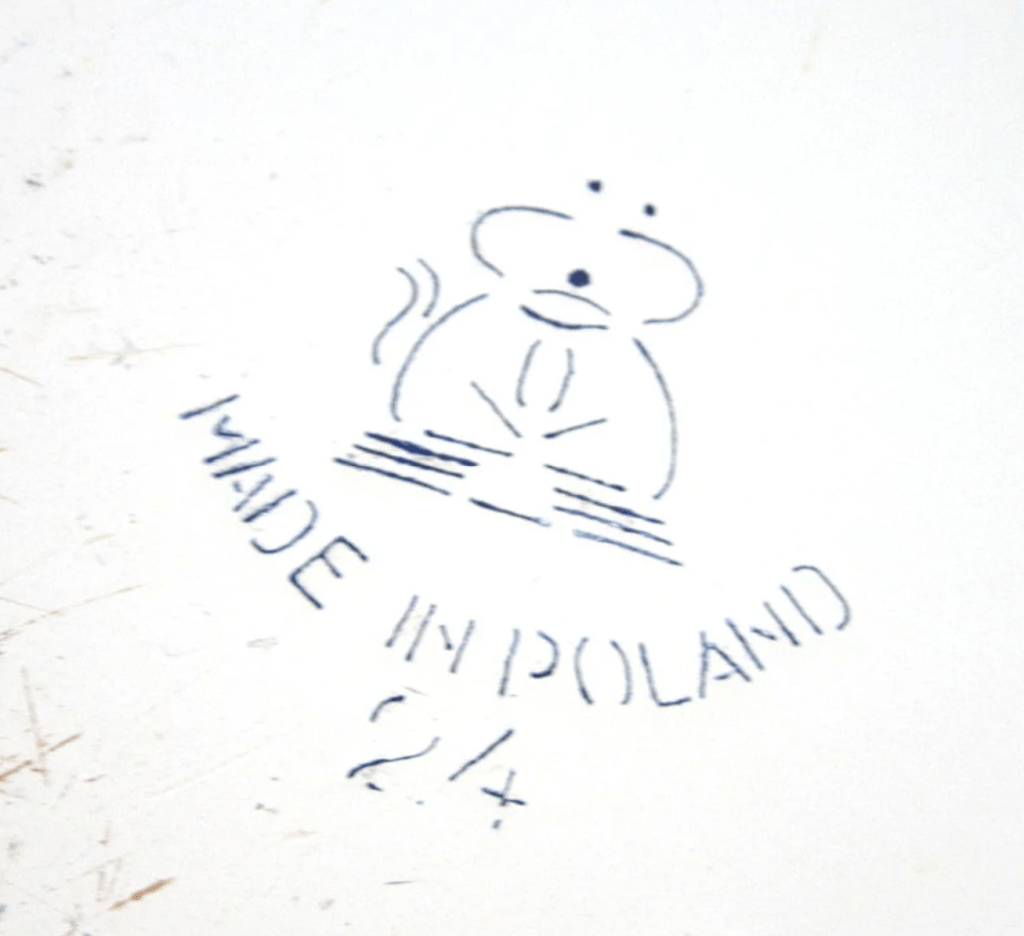
I reached out to a few sellers and asked how they determined their item was from Schindler’s factory and they all gave the same answer: I saw another listing that had the same maker’s mark and said it was made in Oskar Schindler’s factory.
Etsy and eBay are filled with amateurs selling vintage items, and if that’s the only source a seller is checking, then it’s not surprising there are so many grossly misinformed listings. However, one seller I reached out to sent me the listing she had used, which came from the website of an antiques seller in Great Britain.
Atlas Antiques claimed this enamel teapot13 was made in Schindler’s factory and the mark, the teapot with an “O” inside and the “MADE IN POLAND”, was Schindler’s mark. There’s a long text about the history of the factory that accompanies several photos.If you explore the site further, there are many other WWII and Holocaust items for sale and the site, overall, comes across as professional. For someone trying to identify a similar object, but hasn’t bothered to do background research, it would be easy to think this was correct.
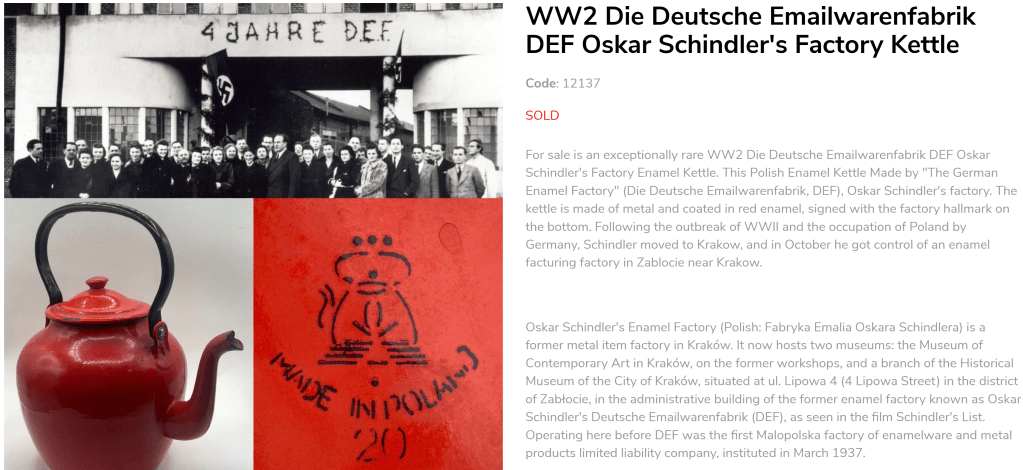
But the most convincing listing I found came from Dynasty Auctions14, an auction site in Israel that SPECIALIZES in Jewish and Israeli items. They sold an enamel cup made in Schindler’s factory for a whopping $4,400 in 2023. The shaky provenance states that the owner lived in Podgórze during the war, which is the district of Kraków that held Schindler’s factory, the Jewish ghetto, and the Płaszów concentration camp. Their site lists other sold Schindler enamelware15, all of them bearing the same tea kettle with an “S” mark and “MADE IN POLAND” stamp. I suspect this site is the source of the misinformation.
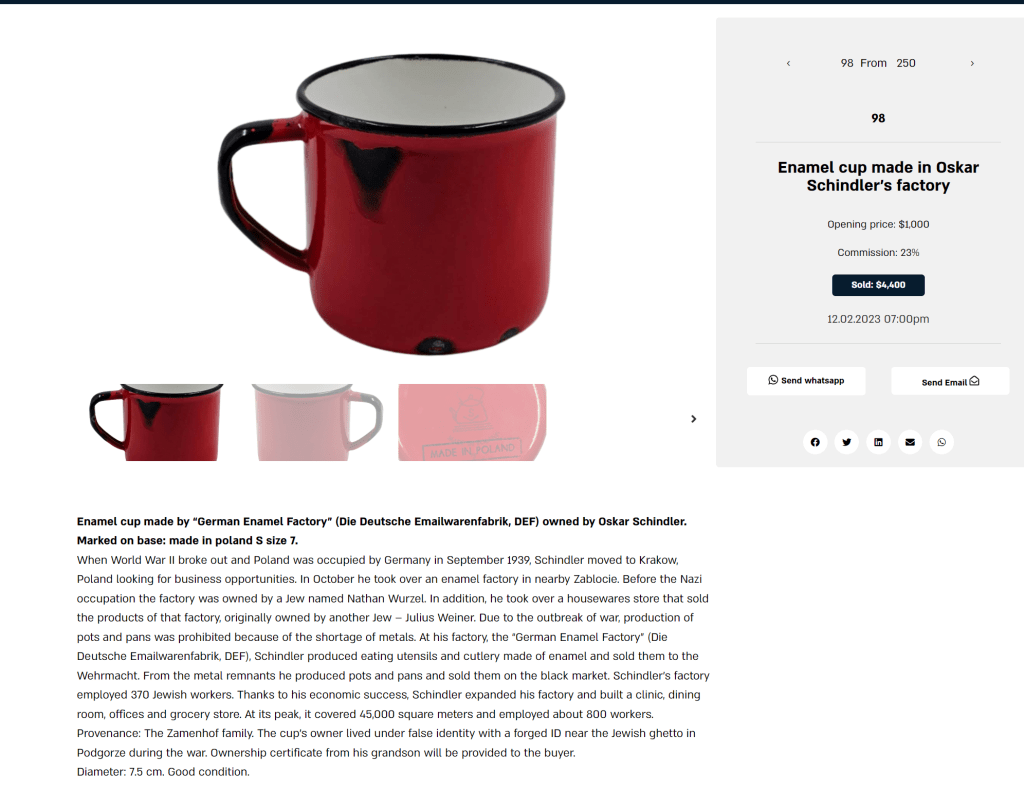
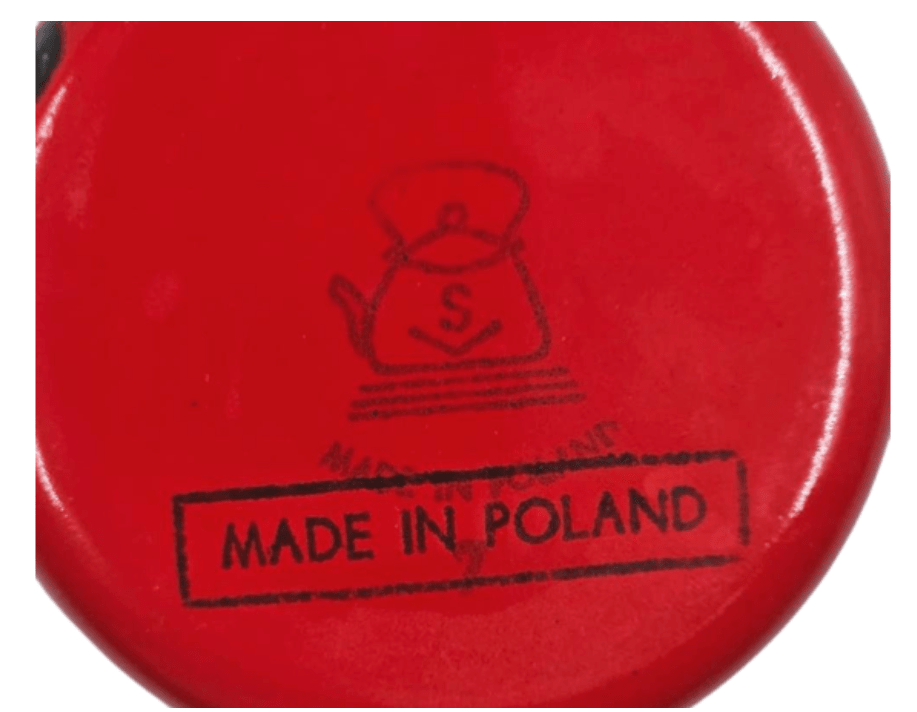
Going back to the background history provided previously, with the key information that Nazis considered the state of Poland non-existant, the area of the factory was in a state of Germanization, and the name of Schindler’s company itself included the word “German” in it, we can definitively conclude a “MADE IN POLAND” stamp would rule out these maker’s marks as those of the Oskar Schindler factory. But if they weren’t made by Schindler’s factory, then who made them? We’ve seen two maker’s marks in these listings, a teapot with an “O” inside and a teapot with an “S” inside. Neither letter stands for “Oskar” or “Schindler.” I am not an expert in vintage enamel cookware, but I am a professional librarian. It just takes the right research skills and a bit of tenacity to identify these correctly, and I will explain how I did it.
My first step was to search all Polish enamel cookware on auction/reselling sites and review the listings. This was so I could get a general idea of companies, names, and maker’s marks to start investigating. I found many listings with similar looking pieces of enamel cookware with the same maker’s mark and the majority were named as manufactured by Huta Silesia. Going back to the previous lesson learned, this could be another case of sellers copying wrong information from another wrong seller. But now I had a clue to investigate.
Next, I ran a general Google search of Huta Silesia. My results were listings from eBay, Etsy, and other reseller listings. A few Pinterest links. Funnily enough, I found someone else had been trying to identify the tea kettle with an “O” mark on the eBay community16 and the voted best answer was a link to the same question being asked on Collector’s Weekly,17 only the mark in question there was the tea kettle with an “S.” A comment on an Imgur photo of an enamel pitcher18 confirmed the mark as Huta Silesia while also incorrectly stating the tea kettle with an “O” as Schindler’s.
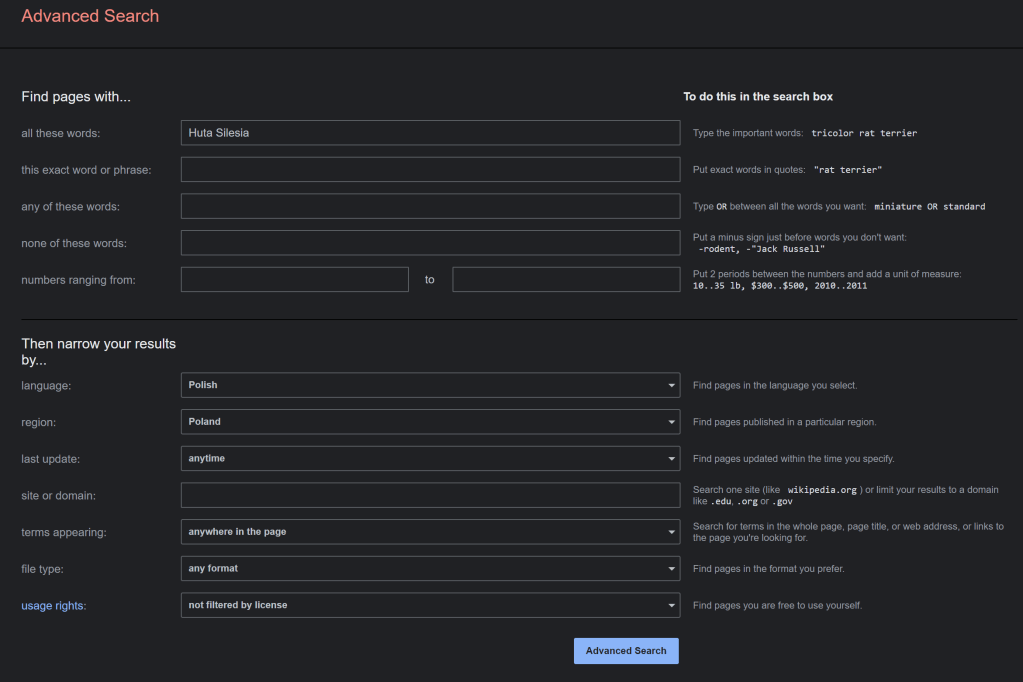
My next step was to see if the company still exists and if they have a website. If so, the website may display their maker’s mark or list a contact I could email and confirm the mark with. Some companies, especially large ones, keep archives and have a dedicated archivist on staff. Since my earlier Google search wasn’t productive and a company website didn’t turn up in the results, I changed the language to Polish and region to Poland in the Advanced Settings on Google. By doing this, my search results would display only indexed pages written in Polish and published from Poland, rather than pages written in English. This tactic turned out to be the key in identifying these maker’s marks.
I should mention that I’ve been studying the Polish language for a few years, so I felt comfortable navigating through the results. However, if this was a language I was unfamiliar with, then I would use the Chrome browser, right-click on my results page and select the “Translate to English” option. From my Polish results I was able to gather some information about Huta Silesia.
Huta Silesia was a Polish steelworks in Rybnik, a city in southern Poland, that operated from 1753 to 2000. They manufactured HUGE amounts of enamelware, as well as “indestructible” refrigerators19. I got the impression they were the Polish equivalent of Corningware, found in every household and still sitting in your Grandma’s cupboard today.
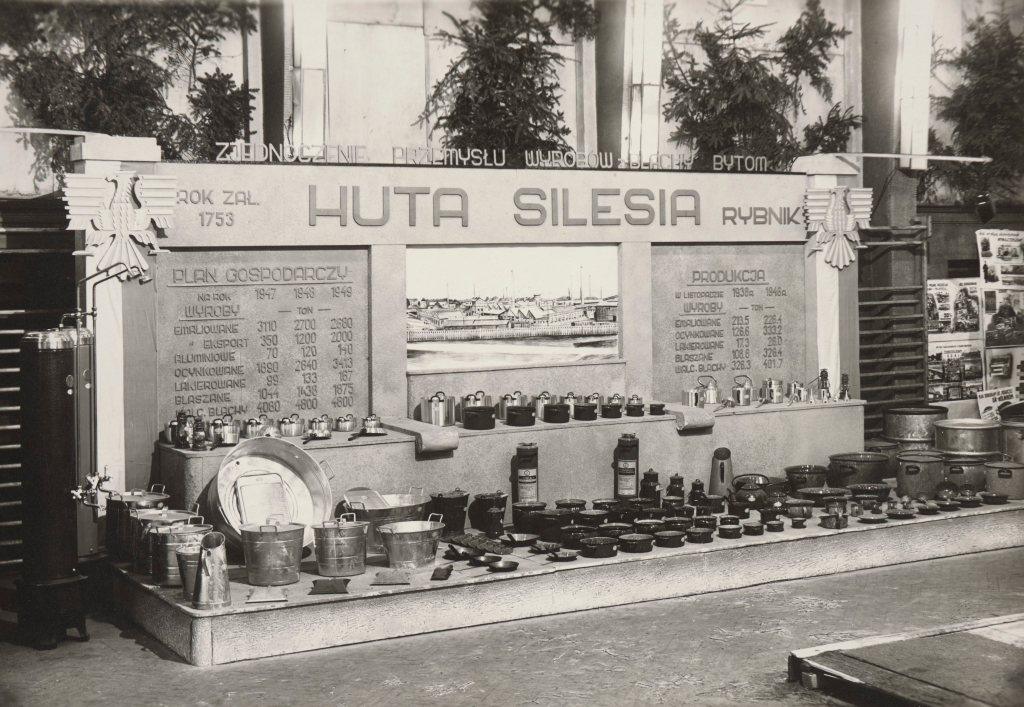
Since the company no longer exists, I sifted through some of the results that discussed the history of the company and provided old photos. On those sites, I couldn’t find an image of a maker’s mark and the company logo was a goat carrying a tea kettle.20 But my results also included past listings from the Allegro Archive21, a giant e-commerce site in Poland. From there I was able to find enamel cookware listings that listed the product as made by Huta Silesia with a maker’s mark of a tea kettle with an “S” inside, including a pot that still had the Huta Silesia label on it.22
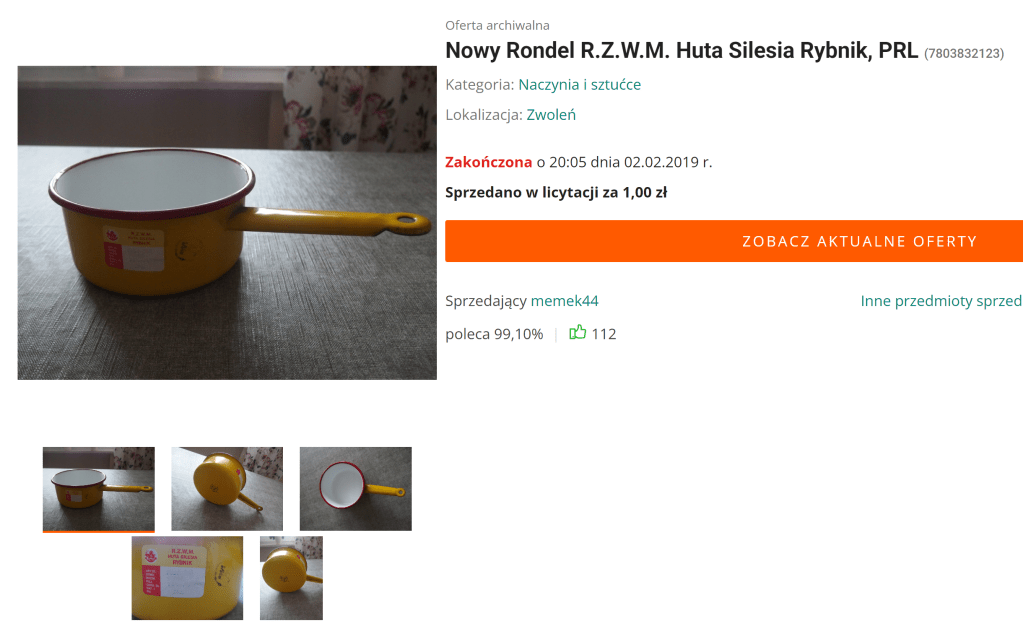
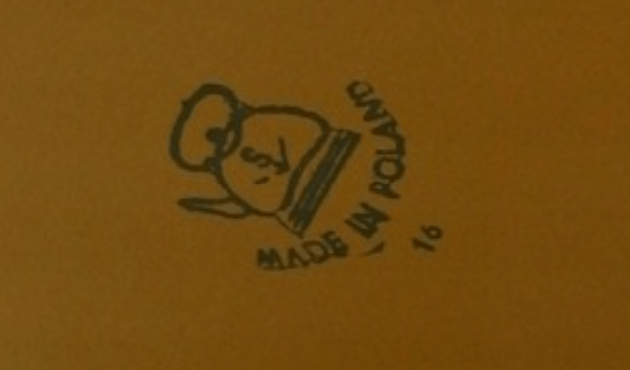
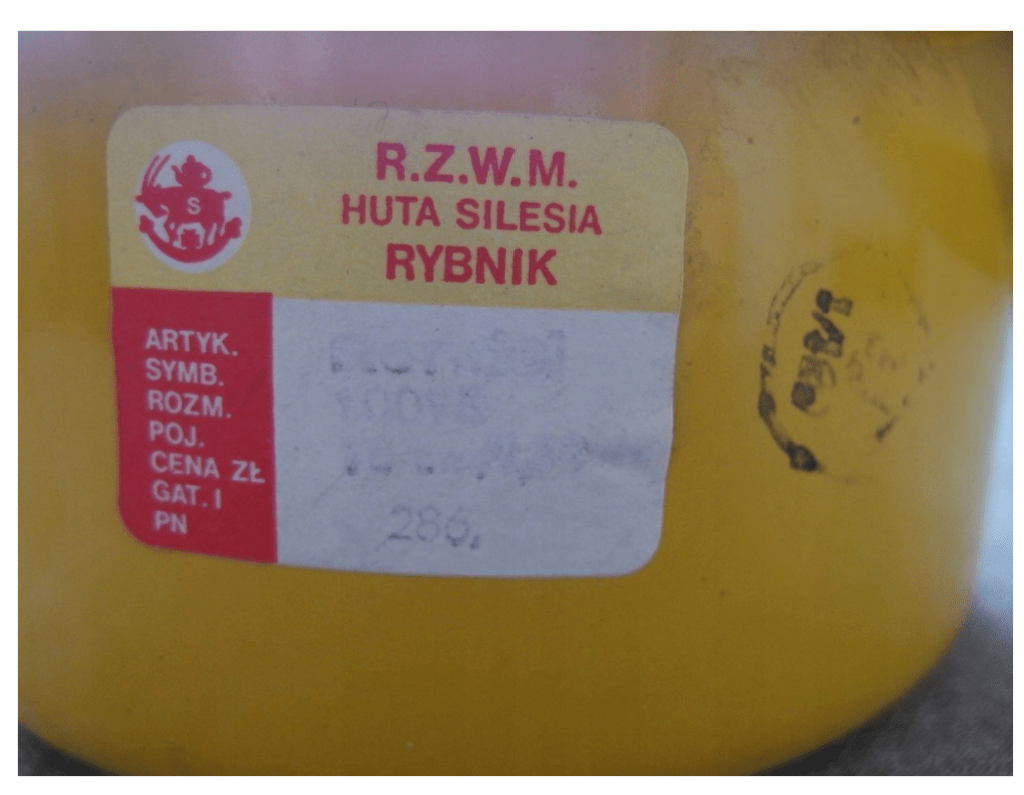
You would think this would be enough proof, but I wanted more. Using the previous method of searching Polish pages published in Poland, I ran a Google search using the terms “Huta Silesia” and “znak towarowy” (the English translation of this would be “trademark”). Lo and behold, the very first result was a database of Polish trademarks.23 There’s the tea kettle with the “S.” Beautiful.
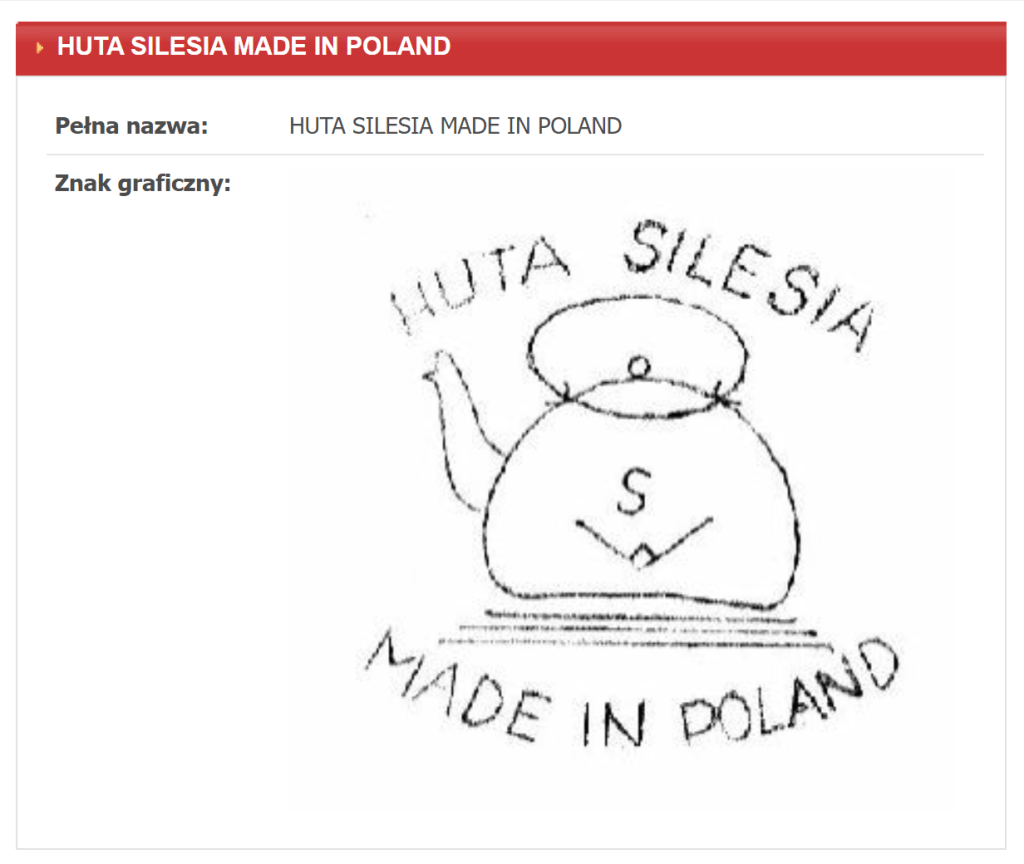
At this point, if I hadn’t been able to identify this mark, my next step would be to find a book, either through the Internet Archive, HathiTrust, or my local library (using an Interlibrary Loan if needed). A search on Google books turns up a few print books about Antique Enamelware24 and at least one on Huta Silesia25 design. Another lazier option would be to contact an archival institution or library in the area of where Huta Silesia was located, such as the Rybnik Museum26, and ask them directly about the mark.
With that maker’s mark confirmed, I moved onto the next one, the tea kettle with an “O” inside. While some listings also listed this maker’s mark as belonging to Huta Silesia, it didn’t make much sense to me. I knew that “Huta” roughly translates to mean iron or steelworks, and since the “S” on the other mark stood for “Silesia”, my hunch was the company or area would start with an O. If I had a name, I could look for a company website or search the trademark database I had just found. So I went back to the Allegro Archive.
One thing I noticed when I was looking at the Huta Silesia listings on the Allegro Archive was that many used “PRL” in the title. PRL stands for Polska Rzeczpospolita Ludowa, or Polish People’s Republic. It refers to a time period, 1952–1989, when Poland was under communist rule. I ran a search using “emaliowany” (an adjective, which means enameled) and “PRL” then looked for any listings that looked like the company started with an “O.”
And there we go. I had a clue, Olkusz,27 to investigate.
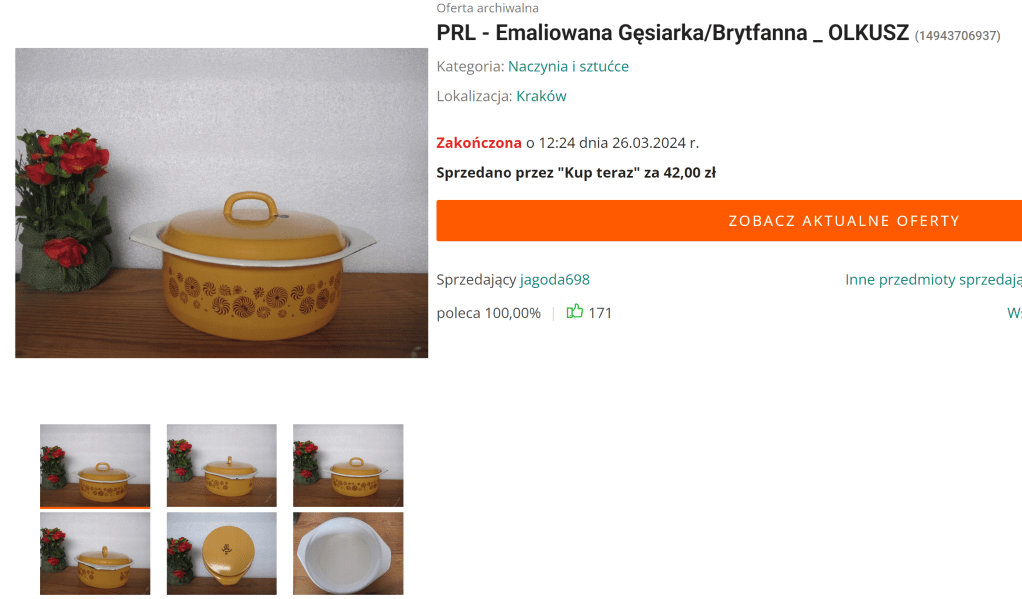
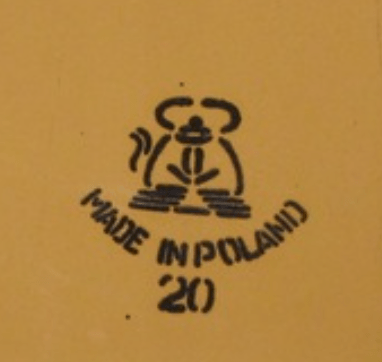
A simple search of “Olkusz” turned up results about a city in Poland. Getting closer. I added the term “emaliowany” and the first result was a website for a company named “Emalia Olkusz S.A.”28 The logo was a modern style tea kettle with an O inside. Promising. The site has a nice “Informacje” (Information) section and in that section, a page about the evolution29 of the logo. It was almost too easy.
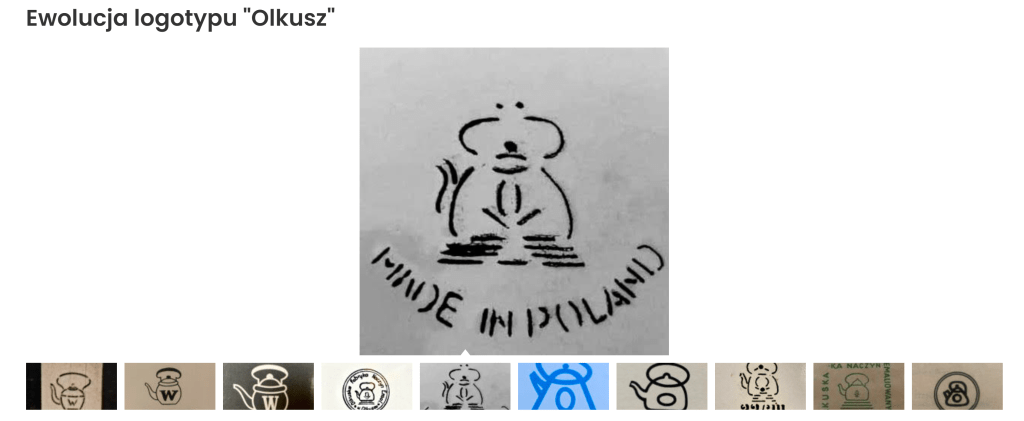
For the record, I did tell the Etsy and eBay sellers I had talked to that their listing was incorrect and and sent along proof of the maker’s mark. All of them, except for one, expressed gratitude and promptly changed their listing so it displayed correct information. The one standout never removed the “Oskar Schindler” from their listing.
By now you may be wondering, well, what does an actual piece of enamelware from Schindler’s factory look like? Since a piece of enamelware from Schindler’s factory would be of high historical significance and value, I thought there may be pieces in a museum. The only museum I found an example in was Yad Vashem’s collection, where they have two items, a cup made in the factory in Kraków30 and a cup made in the factory in Brněnec.31 Unfortunately, neither photo show the maker’s mark or gives identifying information in the details.
However, WWII memorabilia is immensely popular and there are a number of auctioneers/sellers, forums, and online reference libraries32 run by dedicated and knowledgeable people. I searched through a few of these to see if I could find any examples of Oskar Schindler enamelware as well as gain some general information about what these items may look like.
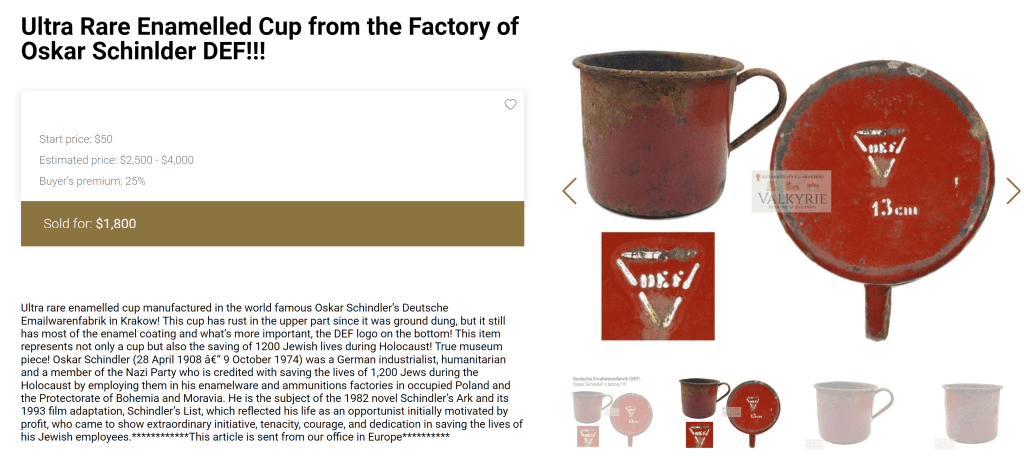
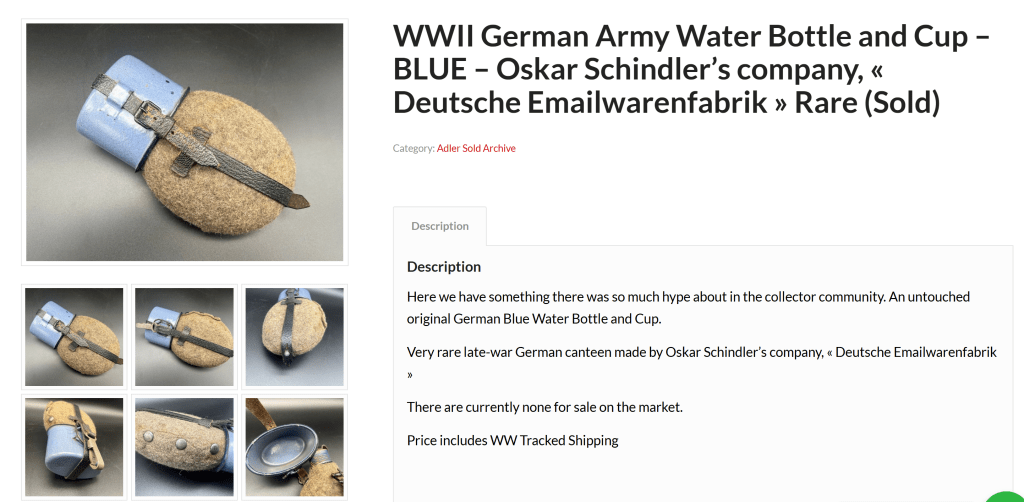
From what I gathered, Oskar Schindler pieces are exceedingly rare. The issue is that many of them are unmarked and only identified by colors that were used only by the Schindler factory. If they are marked, the maker’s mark is a “DEF” inside an inverted triangle.
This listing from Valkyrie Auctions,34 an enameled cup, shows a DEF logo inside an inverted triangle. The piece certainly looks like it fits the time frame and was used by the Wehrmacht.
Here’s an unmarked water bottle34 and cup from Schindler’s factory, listed by Adler Militaria. Again, it looks like it fits the time frame and would be something used by the Wehrmacht.
If you honestly suspect you have an Oskar Schindler piece of enamelware, an extremely historically valuable item, then it’s worth it to get it looked at by a professional and appraised.
I want to close this with a few thoughts and why I found those eBay and Etsy listings unsettling. There is a lot of controversy that surrounds the reselling of Holocaust and Nazi items.35 Ebay36 and Etsy37 both have policies surrounding the sale of these items (though rarely enforced) and the majority of Holocaust/Nazi item auction/seller sites I visited while researching this featured disclaimers claiming they do not support the ideology behind these items. The moral and ethical concerns of reselling enamelware from Oskar Schindler’s factory, who gets to own these items,38 as well as the classification of these items (Is it a military item? Is it a Holocaust item? Is it a Nazi item?) are topics for another blog post, though I only have opinions and not answers.
Whether a seller likes it or not, the listings they create become records and are used as a source of information. Not performing due diligence and making false claims can lead to all sorts of implications. In the case of these inaccurate Oskar Schindler listings, the claim of enamelware made during that time and place, in a factory run by a Nazi, while featuring a MADE IN POLAND stamp, creates an erasure of the violent Germanization period where Poles were robbed of their nation and national identity. It’s a way of creating misinformation and given the amount of conspiracy theories and Holocaust denial that’s taking place today, there’s a very real responsibility when dealing with items from the Holocaust/WWII time period.
Ultimately, what I found unsettling was the casualness of the listings from sellers who genuinely thought their enamelware piece was manufactured in Oskar Schindler’s factory during the Holocaust. It’s troubling these sellers didn’t recognize the historical value, as well as the emotional significance, these items carry. These were objects made by forced Jewish labor during one of humanity’s darkest times; the idea of cooking and serving soup from one of the pots is absolutely ghastly. This is enamelware that should be preserved, not sold as cookware for everyday use.
I want to end by saying we live in a remarkable time where information is easily accessible, as well as the ability to connect with knowledgeable individuals who love to share their knowledge. My hope in writing this piece is that maybe someone out there learned a new online search skill or a new piece of history. But what I really hope happens is these false Oskar Schindler enamelware items stop getting sold online.


 Efemeryda
Leave a reply to Krista Cancel reply